145. How 9-5 Professionals Start a Business With Less Risk: "The Authority Bridge" with Mitch Matthews
Jan 06, 2026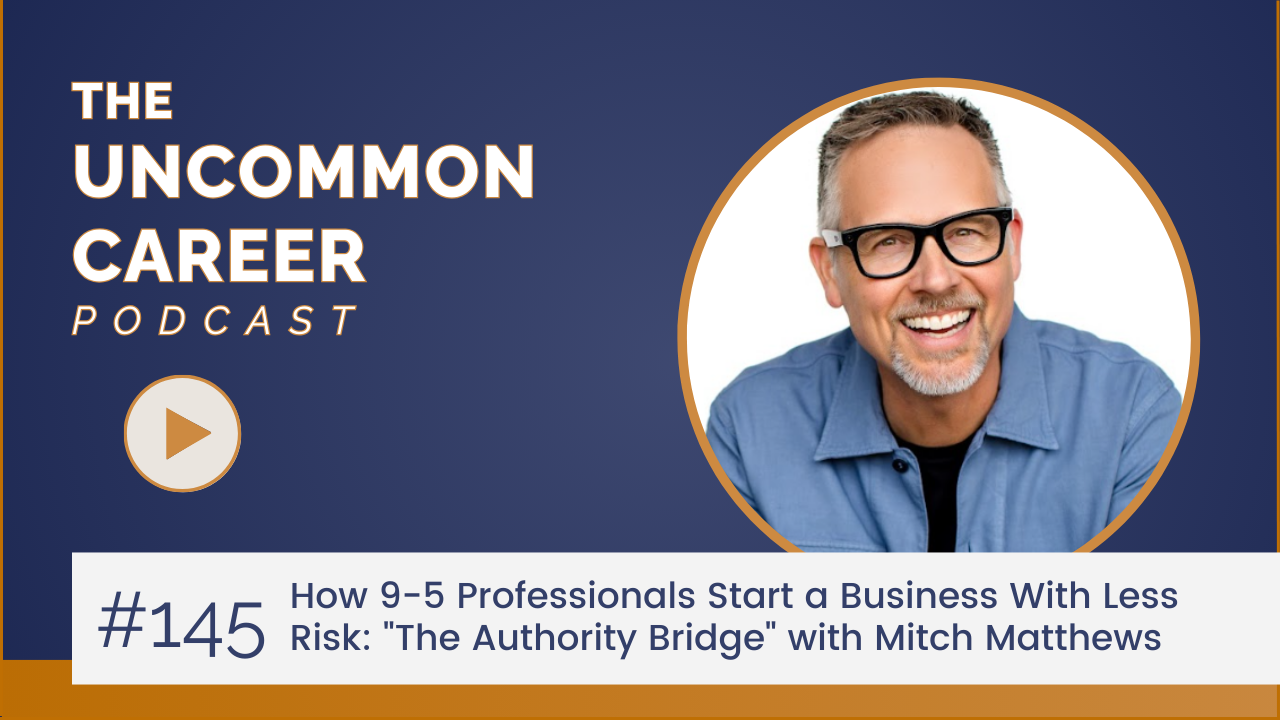
Build the Bridge: Start a Business While Keeping Your 9–5
Big leaps get all the attention, but small, repeatable steps do the heavy lifting.
For many high-achieving professionals, the safest path into entrepreneurship isn’t quitting on Friday and launching on Monday—it’s designing a bridge. Mentioned once here, Mitch Matthews calls it the “Authority Bridge”: a step-by-step way to grow credibility, clients, and cash flow while staying employed. The core idea is simple: don’t gamble your future on a single jump; compound your odds with a proven sequence.
This segment distills that sequence into practical moves that you can implement without burning out—or burning bridges.
|
Listen on your favorite podcast app: |
     |
Why a Bridge Beats a Leap
Career realities—mortgage, family, benefits, reputation—make “just jump” advice expensive and unrealistic. A bridge approach embraces constraints and uses them as design inputs.
Instead of asking, “How do you find the courage to leap?” ask, “How do you architect momentum while protecting today’s stability?” That framing turns entrepreneurship from an identity test into an operational plan. It also reduces the two biggest risks: running out of time and running out of confidence.
-
Lower risk, higher signal: build traction (content, interest, first customers) before changing your income source.
-
Keep your edge at work: side experiments often reignite energy, making you sharper in the day job.
-
Learn in public—lightly: credibility grows through visible, useful thinking, not grand announcements.
Mitch Matthew's Authority Bridge: Three Phases That Compound
Phase 1: Covered Authority
Stay employed. Deliver excellence.
Quietly start publishing one useful idea per week—the “lighthouse post.” Teach from the journey, not a distant destination: one problem observed, one insight, one practical step. No “I’m launching a company!” fanfare—just consistent value tied to the domain you intend to serve. Over time, those posts attract conversations, and conversations reveal problems people will pay to solve.
-
One asset a week: post, article, short video, or thread answering a frequent question.
-
Solve, don’t self-promote: usefulness is the best marketing at this stage.
-
Name the niche by the problems it has, not the labels people wear.
Phase 2: Emerging Authority
When signals show up (DMs, replies, requests), move from “just sharing” to “also offering.” Keep the job; add services in a controlled way. Clarify boundaries with your employer where needed. A simple offer suite—e.g., a starter consultation and one core package—prevents custom-work chaos. The message is, “Still fully committed at work; also taking on a limited number of clients in this focus.”
-
Two offers only: a paid diagnostic and a flagship engagement; nothing else for now.
-
Calendar control: fixed windows for calls; protect recovery time.
-
Keep posting weekly: content fuels discovery and establishes trust.
Phase 3: Independent Authority
Only when capacity, demand, and savings align do you remove the W-2. By then, positioning, processes, and pricing have been tested, and “going solo” becomes a scaling decision—not a Hail Mary.
-
Replace income before replacing payroll: a trailing 3–6 months of validated revenue is a strong signal.
-
Document the ops: proposals, onboarding, delivery, invoicing—make each a one-page checklist.
-
Raise standards as you raise capacity: protect the model that got you here.
Give Yourself Permission to Be New
High performers resist beginner energy because reputation feels fragile. Believe it or not, that fear slows action more than market conditions ever will. Reframe “being new” as “running disciplined experiments.” Early steps will feel awkward; that’s not a verdict on fit, it’s your nervous system learning a new role. Pair humility with structure: decide what to try, define what “good” looks like, and give each test a fair run before judging it.
-
Identity shift: not “unqualified”—qualified in one arena, novice in another, learning fast.
-
Two-metric rule: each experiment has a success metric (e.g., booked calls) and a learning metric (e.g., objections heard).
-
Stop comparing year 1 to someone else’s year 10.
The Scientific Method for Entrepreneurship (Plan → Test → Learn → Adjust)
Strategy is a hypothesis; the market is the lab. Treat ideas like experiments: form a best-guess plan, test with a small audience, and let results—not ego—decide the next move. When outcomes diverge from expectations, label it “data,” not “failure.” This mindset makes iteration emotionally sustainable and operationally inevitable.
-
Hypothesis: “Leaders in X industry will pay for Y outcome.”
-
Experiment: three lighthouse posts + one low-friction offer to validate interest.
-
Measure: replies, opt-ins, booked calls, paid pilots.
-
Adjust: refine audience, message, or offer based on what actually happened.
Start With a Problem, Not a Persona
Titles buy attention; problems buy decisions. “Who do you serve?” is useful, but “Which problem do you solve?” is decisive. Your bridge gets sturdier when every asset—post, call, or offer—ties to a real, expensive problem. Tangible outcomes convert faster than vague inspiration.
-
Define the pain in operational terms: delays, rework, churn, missed targets, risk exposure.
-
Quantify the cost: time lost, revenue leakage, error rates, morale impact.
-
Make outcomes concrete: faster cycles, cleaner handoffs, higher retention, fewer escalations.
Build Authority with One Weekly “Lighthouse”
Consistency beats intensity. One high-quality weekly post compounds more than sporadic sprints. Think “teach from the journey”: document lessons you’re actively learning, not grand theories. This keeps content authentic and inexhaustible, and positions you as a practitioner—not a commentator.
-
Simple format: pain → insight → small next step.
-
Channel minimalism: pick one primary platform where your buyers already look for help.
-
Stack credibility: occasional long-form explainer or toolkit download anchored to the same problem space.
Offer Stacks and Day Jobs
Early variety looks like opportunity but behaves like entropy. Two offers focus your energy and simplify delivery: a paid diagnostic (short, scoped, outcome-tight) and a flagship engagement (the repeatable transformation you do best). This reduces context switching, clarifies pricing, and increases client results.
-
Diagnostic: fixed price, fixed scope, fixed deliverable (e.g., roadmap, audit, action plan).
-
Flagship: 6–12-week container with clear milestones; no custom one-offs until capacity allows.
-
Upgrade path: move successful diagnostics into the flagship; say “no” to misfits early.
While you're busy with offer stacks, make sure not to leave your current job just yet!
Excellence at work is non-negotiable. Treat the job as both responsibility and R&D. Learn what leaders actually buy, how decisions move through organizations, and which metrics trigger investment. If your employer welcomes it, frame your growing expertise as an asset—credibility tends to spill over.
-
Deliverables first: side work never eclipses core commitments.
-
Ethics check: avoid conflicts, use personal time, and keep boundaries explicit.
-
Observation lab: listen for language executives use when they green-light spend.
Train on Purpose (Skill Before Scale)
Natural talent is not a strategy. Acquire the missing skills deliberately—sales conversations, scoping, pricing, facilitation, content cadence. Training collapses trial-and-error time and prevents the most expensive mistakes (over-customization, under-pricing, scope creep). Think of it as specialized surgery training before picking up the scalpel.
-
Curriculum picks: one sales framework, one delivery framework, one content rhythm.
-
Practice reps: mock calls, sample proposals, dry-run workshops—debug before you sell.
-
Tooling: templates for proposals, SOWs, invoices, and retros so quality is consistent under pressure.
But we have to be realistic in approaching this - what about burnout? How can it be prevented?
Capacity is a constraint to respect, not a badge to ignore. A sustainable bridge sets ceilings: number of clients, hours per week, and a clear “not now” list. Growth that requires constant heroics won’t survive the transition to full-time.
Build a small, calm system that scales because it’s simple, not because you’re sprinting.
-
Caps: e.g., two concurrent clients, 5–8 side hours/week, one weekly content asset.
-
Recovery blocks: no-meeting evenings, device-free windows, intentional rest.
-
Quarterly review: prune low-yield activities; double down on channels that convert.
When to Cross the Bridge
Don’t let excitement or exhaustion choose your timing. Use evidence: sustained inbound interest, a waitlist, savings runway, and repeatable ops. When the math and the momentum align, the move stops feeling like a gamble and starts feeling like the next logical step.
-
Signals you’re ready: consistent paid demand, clear positioning, confident pricing, and a calendar model that already works part-time.
-
What to avoid: quitting to “find time,” hoping pressure will produce clarity. Clarity comes from validated learning, not empty calendars.
Entrepreneurship doesn’t have to be a cliff.
Treat it like a bridge: keep the role that pays today, publish one useful insight each week, validate a focused offer, and let experiments—not ego—shape the model. Train the missing skills on purpose. Protect energy so progress survives real life. When the signals converge, step over with evidence and confidence.
That’s how 9–5 professionals become business owners without setting their lives on fire—steady steps, compounding credibility, and a decision made from strength.