143. Leaders, Use This Tool to Create Buy-In Without Over-explaining, with Rebecca Gutner
Dec 23, 2025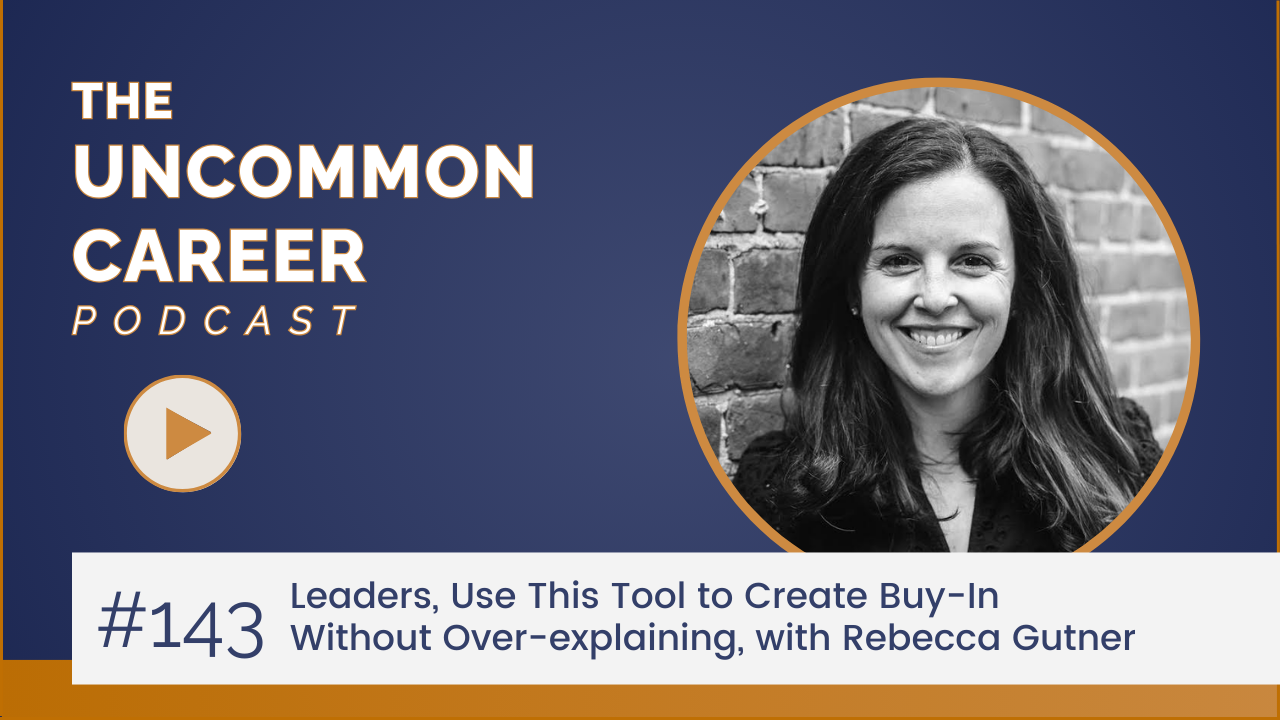
A Leader’s Shortcut to Buy-In: Say Less, Land More
Did you know that a beautiful slide deck can still fall flat when the message feels dry, abstract, or disconnected from what your team actually cares about? Buy-in rarely fails because the goal is “bad”; it fails because people don’t understand the why, can’t see their role, and don’t know what action looks like tomorrow morning.
The good news is that clarity doesn’t require more words—it requires better structure.
When the message connects your team’s work to the organization’s north star, people stop guessing and start moving. When expectations are explicit, “17 questions” shrink into one confident next step. When progress is communicated in a steady rhythm, motivation stays alive long after kickoff week.
Insights in this segment with Rebecca Gutner point to one simple truth: the fastest way to energize execution is to organize your message so it lands emotionally and operationally at the same time.
|
Listen on your favorite podcast app: |
     |
Start With the Why: The Missing Ingredient Behind Most “Dry” Presentations
The most common leadership communication mistake is skipping the why.
Goals get announced, metrics get shown, deadlines get declared—and the team hears a list, not a mission. People want to feel part of something meaningful and to understand how their effort contributes to that bigger picture. When the why is missing, the brain labels the message as “extra work” instead of “shared direction.” When the why is clear, the same workload can feel purposeful and even motivating.
The “why” doesn’t need to be dramatic. It needs to be connective. It explains why these goals matter right now, what the organization is trying to accomplish, and what changes when the team succeeds. That connection is what transforms a slide deck from “informational” into “energizing.”
-
Buy-in grows when people feel part of something. The why turns tasks into contribution.
-
Dry presentations usually aren’t missing data; they’re missing meaning. Meaning is what makes data actionable.
-
A clear why reduces resistance. People execute faster when they understand purpose.
Define the North Star: Make the Destination Obvious
Before a team can move together, the destination has to be named clearly.
That’s what a “north star” does:
- It anchors priorities
- It helps people evaluate tradeoffs
- It prevents random work from creeping into the plan
Without a north star, teams may work hard while pulling in different directions. With a north star, alignment becomes easier because decisions have a shared reference point.
A north star doesn’t mean one metric only; it means one direction. It’s the thing your goals ladder up to: growth, market share, customer trust, retention, innovation, operational excellence—whatever your organization is truly optimizing for. When you name it, your team stops hearing “more work” and starts hearing “the reason we’re doing this.”
-
A north star simplifies priorities. It gives your team a filter for yes/no decisions.
-
People move faster when the destination is clear. Ambiguity is what makes teams hesitate.
-
The north star reduces whiplash. When priorities change, the team can evaluate whether the change truly serves the direction.
Connect the Dots for Yourself First—Then for the Team
If the dots aren’t connected in your own mind, they won’t land cleanly for anyone else. This is where many leaders get stuck: building slides before doing the thinking. The result is a deck that looks good but feels dry—because the story underneath hasn’t been organized.
Dot-connecting means translating the organization’s goals into department priorities and then translating those priorities into the lived reality of your team. It also means addressing the “so what” your audience is silently asking: Why does this matter, what changes, and what is expected from me? When that translation happens, the team feels less confused and more capable. Clarity becomes contagious.
-
If the leader is unclear, the team will be unclear. Clarity must be owned before it can be shared.
-
A deck is not the strategy; the deck reveals the strategy. Weak structure is often a thinking problem, not a design problem.
-
Dot-connecting turns goals into momentum. It helps people see how daily work ladders to meaningful outcomes.
Make It About the Audience: What Will Land With Them
Buy-in isn’t created by talking more; it’s created by talking in a way that resonates. That requires thinking about your audience before you speak. What motivates them? What pressures are they under? What do they fear? What do they care about beyond metrics—growth, mastery, stability, recognition, impact, autonomy?
When you build a message that anticipates your team’s perspective, you remove friction. People feel seen. And when people feel seen, they listen differently. The exact same goal can land as inspiring or exhausting depending on whether the communication acknowledges what your team is carrying and why this direction matters.
-
Resonance is a leadership skill. It’s the difference between being heard and being followed.
-
Audience-first messaging reduces confusion. When your team understands the “why,” fewer questions are needed to start.
-
Buy-in rises when people see themselves in the plan. Not as an afterthought—explicitly.
Translate Goals Into Roles: How Can They Support This?
A goal without role clarity creates anxiety.
Your team hears the outcome, then immediately wonders what it means for their workload, priorities, and performance evaluation. If your message ends at “Here’s the target,” your team will either pepper you with questions or quietly invent their own answers—both outcomes cost time.
The highest-value move is to state the outcome and the “how you can support this” in the same breath. That doesn’t mean micromanaging. It means eliminating ambiguity about expectations. If you’re speaking to one team, it may be one primary action shift. If you’re speaking to a mixed group, different subgroups may need different directives. Either way, people should leave the kickoff knowing what’s expected of them specifically.
-
Outcome-only communication creates 17 questions. Outcome + actions creates momentum.
-
Role clarity helps people feel helpful. People want to drive the mission, not guess at it.
-
Explicit expectations prevent quiet misalignment. What you assume is obvious often isn’t.
Create an Operating Rhythm: Progress Can’t Be “Set It and Forget It”
Kickoff meetings are exciting—for about five minutes.
Then the quarter starts, reality hits, and priorities compete. If your goals communication happens once and then disappears, buy-in decays. Teams need a steady drumbeat—an operating rhythm—that keeps priorities visible and reinforces that progress matters.
An operating rhythm is simply the repeatable way your team stays informed: a dashboard, a monthly email, a quarterly review, a weekly standup segment, a short status note—whatever fits your structure. The tool doesn’t matter as much as consistency. Consistency is what keeps people engaged because it reminds them their effort is contributing to something real.
-
Progress updates keep buy-in alive. People stay motivated when they can see movement.
-
Rhythm builds trust. When leaders report back, teams believe the goals are real and the work matters.
-
Contribution needs to be visible. People want to know their work is having impact.
Track Contribution, Not Just Compliance
Many goal updates unintentionally reduce people to checkboxes: did the task get done, yes or no? But teams are energized by contribution—how their work moved the mission forward—not merely by compliance. A powerful message doesn’t just track whether standards were met; it shows how each group’s effort connects to the broader win.
When you highlight contribution, you reinforce purpose. People see the thread between daily work and company outcomes. They feel part of a shared story, not just a labor engine. This is one of the simplest ways to strengthen culture while driving performance: make contribution visible, consistently.
-
Compliance gets tasks done; contribution gets commitment. Commitment is what carries teams through hard quarters.
-
Visibility fuels engagement. People stay invested when they can see that effort mattered.
-
Tracking should reinforce mission. Updates should answer: “Are we closer to the north star?”
Wrap the Message With One Main Takeaway
A strong close isn’t “Any questions?” It’s a final anchor. People won’t remember 17 slides. They will remember one crisp takeaway if you give it to them on purpose. Think of it like branding: one symbol or phrase can call back the whole message. Your close should do the same—one clear statement that stitches together the why, the goals, and the team’s role.
To make that takeaway stick, choose something simple and relatable: a short phrase, an image, a clean data point—something your audience can recall later when decisions get messy. The aim is memory plus direction: if they remember one thing, they should remember what matters most and what to do next.
-
End with one anchor. “If you remember nothing else…” is leadership, not drama.
-
Make it memorable. A story, image, or simple metric helps the message travel beyond the room.
-
Tie it back to action. A takeaway that doesn’t guide behavior is just inspiration.
Create Buy-In Without Over-Explaining
Over-explaining often comes from a good place: wanting to be thorough, reduce confusion, and prevent mistakes. But too much explanation can overwhelm people and dilute the message. Buy-in comes from clarity, not volume.
Instead of adding more slides, strengthen the structure: why → north star → aligned priorities → audience impact → role clarity → operating rhythm → contribution tracking → one takeaway.
When your message follows a clean structure, it feels alive. It’s easier to deliver, easier to receive, and easier to act on. People don’t need you to say everything. They need you to say the right things—clearly—and then reinforce them consistently over time.
-
Structure replaces over-explaining. When the story is organized, your team doesn’t need excessive detail to understand direction.
-
Clarity creates confidence. Confident teams act faster and ask better questions.
-
Repetition beats length. A steady rhythm of simple updates does more than one long kickoff.
Plan What You’ll Say, Then Lead With It
Leaders don’t just set goals—they set tone.
Taking time to plan what you’re going to say, where you’re headed, and what steps it will take to get there makes the journey more enjoyable for everyone involved. When you connect the why, define the north star, align priorities, clarify roles, and build an operating rhythm, your team stops spinning and starts executing.
The result is buy-in that doesn’t require constant persuasion—because the message makes sense, the expectations are clear, and progress is visible.
That’s how you create momentum without over-explaining: say less, land more, and let clarity do the motivating.